
This article is simply on how to write a job application email for beginners. Many first-time applicants struggle with what to say and how to sound professional. Your job application email is often the first impression an employer will have of you. In this simple guide, you’ll learn exactly how to write a job application email for beginners the right way.
A job application email should be short, clear, and straight to the point. It is not the same as your CV; instead, it serves as a brief introduction that explains who you are, the position you are applying for, and why you are a good fit for the role.
When learning how to write a job application email for beginners, it’s important to focus on professionalism, proper structure, and polite language. A well-written email shows employers that you are serious, organized, and ready to work.
From my experience helping beginners apply for jobs, I’ve seen that a simple, well-structured email often makes a stronger impression than a long, poorly written message.
That means your email can either get you invited for an interview, or it can make your application get ignored completely. Many job seekers make simple mistakes like:
Writing “Hi” instead of a professional greeting
Sending blank emails with only attachments
Using poor subject lines
Not explaining their value
These mistakes can cost you opportunities — both in Nigeria and abroad. This complete guide I have given here will teach you the following;
- How to write a professional job application email
- The correct format and structure
- Real examples you can copy
- Mistakes to avoid
- Tips to increase your chances of getting hired
Whether you are applying for:
A local job in Nigeria
Or a job abroad
This guide will help you do it the right way.
READ THIS: How to Write a CV for International Jobs from Nigeria
What is a Job Application Email?
A job application email is a formal email sent to an employer to express your interest in a job opening. It usually includes;
A short introduction about you
The position you are applying for
Your qualifications
A statement of interest
Your CV and documents as attachments
Think of it as your mini cover letter inside an email.
When to Use a Job Application Email
Use a job application email when:
The job advert says “send your CV to this email.”
You want to apply directly to a company
You are applying for a remote job
You are sending a speculative (unsolicited) application
Structure of a Professional Job Application Email
A perfect job application email contains 7 important parts:
1. Subject Line (Very Important)
Your subject line must be clear and professional.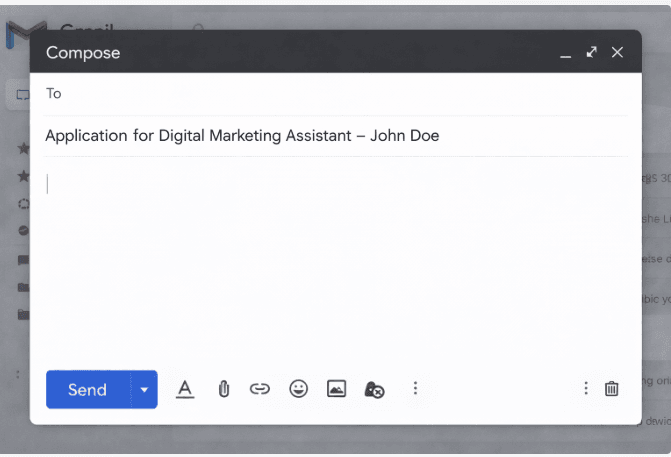
Good Examples:
Application for Digital Marketing Assistant – John Doe
Application for Mechanical Technician Position – Ref 2026
Job Application – Customer Service Representative
Bad Examples:
CV
Job
Hello Sir
2. Professional Greeting
Always use a respectful greeting:
Examples:
Dear Hiring Manager
Dear Sir/Ma
Dear HR Manager
Dear [Company Name] Recruitment Team
3. Opening Paragraph (Introduction)
In 1–2 sentences, state:
Who you are
The job you’re applying for
Where did you see the job
Example:
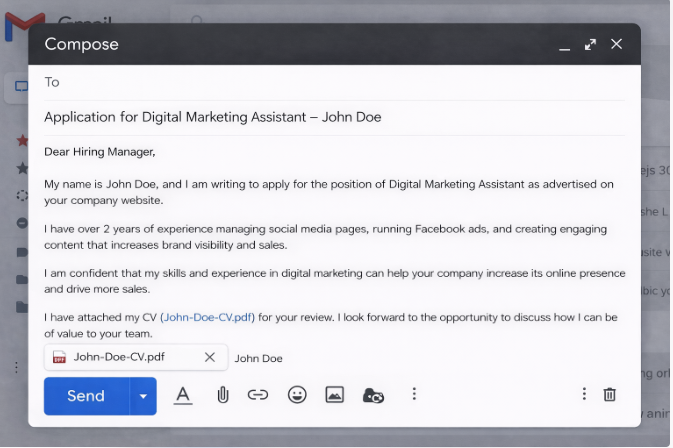
My name is John Doe, and I am writing to apply for the position of Digital Marketing Assistant as advertised on your company website.
4. Middle Paragraph (Why You Are Qualified)
This is where you sell yourself.
Talk about:
Your skills
Your experience
Your achievements
Example:
I have over 2 years of experience managing social media pages, running Facebook ads, and creating engaging content that increases brand visibility and sales.
5. Value Proposition (Why They Should Hire You)
Tell the employer what you can do for them.
Example:
I am confident that my experience in digital marketing and content strategy will help your company grow its online presence and attract more customers.
6. Closing Paragraph
End professionally.
Example:
I have attached my CV for your review. I would appreciate the opportunity to discuss how I can contribute to your team.
7. Professional Sign-off
Examples:
Kind regards
Best regards
Yours sincerely
Then include:
Your full name
Phone number
Email address
Complete Sample Job Application Email
Sample Email
Subject: Application for Social Media Manager – Bartholomew Miracle
Email Body:
Dear Hiring Manager,
My name is Bartholomew Miracle, and I am writing to apply for the Social Media Manager position advertised on your website.
I have practical experience managing Facebook business pages, running paid ads, and creating engaging content that helps brands grow their audience and increase sales. Through my work with platforms like Educatefresh and Miratech Media, I have developed strong skills in digital marketing, customer engagement, and online branding.
I am confident that my skills and dedication can contribute positively to your organization by improving your online visibility and customer engagement.
Please find my CV attached for your review. I would appreciate the opportunity to discuss how I can add value to your team.
Thank you for your time and consideration.
Kind regards,
Bartholomew Miracle
070XXXXXXXX
youremail@gmail.com
How to Attach Your CV Properly
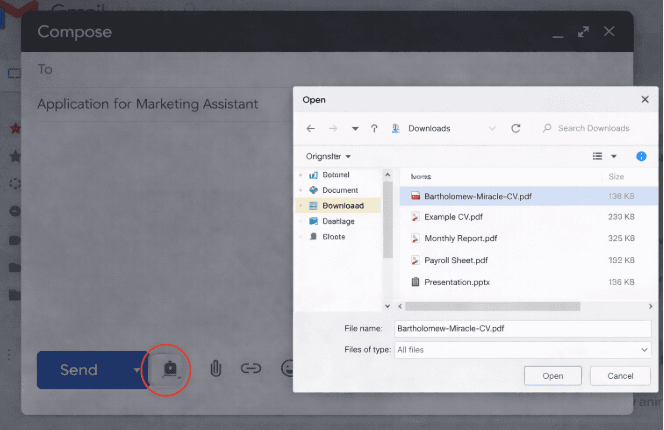
To attach your CV properly, ensure your CV is renamed with a professional file name:
From CV.pdf to Bartholomew-Miracle-CV.pdf
Common Mistakes to Avoid
Avoid these mistakes:
Sending empty emails with an attachment only
Using an unprofessional email address (like coolboy123@gmail.com)
Spelling errors
Using “Hey” or “Hi”
Writing too long emails
Forgetting to attach a CV
Tips to Increase Your Chances of Getting Hired
1. Customize Each Email
Avoid sending the same generic email to every employer. Always mention the company name, the exact job position, and one or two specific reasons you’re interested in that role.
2. Use Keywords from the Job Description
Carefully read the job posting and identify important words related to skills, qualifications, and responsibilities.
Many companies use Applicant Tracking Systems (ATS) to filter applications, and using the right keywords increases your chances of passing the first screening stage.
3. Keep It Short and Clear
Recruiters receive dozens — sometimes hundreds — of emails daily. Long, unnecessary stories can reduce your chances of being read completely.
Your email should clearly state who you are, the position you’re applying for, and why you are a good fit — all in a few short paragraphs. A clear, direct message makes it easy for the employer to quickly understand your value and move on to your attached CV.
4. Use a Professional Tone
Avoid slang, emojis, overly casual greetings, or informal phrases like “Hey” or “What’s up.” Proper grammar, correct spelling, and polite language create a positive impression and show that you take the opportunity seriously. Greetings such as “Dear Hiring Manager” should be used or by the name provided.
5. Follow Up After 5–7 Days
If you don’t receive a response within 5–7 days, it’s appropriate to send a polite follow-up email. Following up demonstrates confidence, seriousness, and genuine interest in the opportunity. However, avoid sending too many follow-ups too quickly, as this may come across as pushy.
Job Application Email for Remote Jobs
Remote employers look for:
Communication skills
Digital skills
Time management
Make sure your email highlights these.
Job Application Email for International Jobs
If applying abroad:
Use formal English
Mention certifications (IELTS, etc.)
Highlight global experience
My Personal Experience Applying for Jobs
From my experience developing platforms such as Educatefresh and other ventures, I’ve realized that a strong, well-written email can unlock real opportunities. At the beginning, I used to send:
Empty emails
Poor subject lines
But after improving my email writing:
I started getting responses
Clients began to take me seriously
My opportunities increased
Today, I teach others to use professional communication to grow their careers.
Advanced Tips for Standing Out
Add a portfolio link
Add LinkedIn profile
Mention specific results
Keep formatting clean
Follow-Up Email Example
Subject: Follow-up on Job Application – Digital Marketing Assistant
Dear Hiring Manager,
I hope this message finds you well. This is a follow-up regarding the application for the Digital Marketing Assistant position submitted on [date].
The opportunity remains of great interest, and any update on the status of the application would be sincerely appreciated.
Thank you for your time.
Kind regards,
Your Name
Best Time to Send Job Application Emails
Send your email:
Between 8:00 AM and 11:00 AM
Weekdays (Monday–Friday)
Avoid weekends.
Tools to Help You Write Better Emails
Grammarly
Frequently Asked Questions (FAQs) – Job Application Email
1. What should I write in the subject line of a job application email?
Your subject line should clearly state:
The job title
Your name
Example:
Application for Customer Service Representative – Bartholomew Miracle
Avoid vague subjects like:
“CV”
“Job”
“Application”
A clear subject line helps employers identify your email quickly and increases the chance of it being opened.
2. Can I send my CV without writing anything in the email body?
No. This is a very common mistake many job seekers make. You must include the following, even if your CV is attached.
A short introduction
The job position
Why are you applying
Sending an empty email with only an attachment looks unprofessional and lazy.
3. How long should a job application email be?
Your email should be short, clear, and straight to the point
Ideal length:
3 to 5 short paragraphs
About 120–200 words
4. Should I attach my CV as a PDF or a Word document?
The best format is PDF format.
Why PDF is better:
Keeps formatting intact
Looks professional
Works on all devices
Only send a Word document if the employer specifically requests it.
5. What should I name my CV file before sending it?
Use a professional file name:
Correct format:
YourName-JobTitle-CV.pdf
Example:
Bartholomew-Miracle-Digital-Marketer-CV.pdf
Avoid names like:
MyCV.pdf
FinalCVnew.pdf
6. Is it okay to use “Dear Sir/Ma” in a job application email?
Yes, but it’s better to use any of the following;
Dear Hiring Manager
Dear Recruitment Team
Dear [Company Name] HR Team
These are more modern and professional.
7. What if I don’t know the hiring manager’s name?
If the job advert doesn’t provide a name, you can safely use:
Dear Hiring Manager
This is the most commonly accepted professional greeting.
8. How soon should I follow up after sending my job application email?
You should follow up after 5 to 7 working days.
Send a short and polite follow-up email asking for an update. Do not follow up every day — that looks desperate.
9. Can I apply for jobs using my phone?
Yes, you can apply using your phone.
But make sure:
Your CV is properly formatted
You check for spelling errors
Your email looks professional
For best results, use a laptop when possible.
10. How can I make my job application email stand out?
To stand out:
Use a strong subject line
Mention your key achievements
Show how you can help the company
Keep your email neat and professional
Example:
Instead of saying “I am hardworking.”
Say: “I increased social media engagement by 40% in my previous role.”
11. What is the difference between a cover letter and a job application email?
A cover letter is a full document attached to your application
A job application email is the short message you send with your CV
Your email acts as a mini cover letter.
12. What happens after I send a job application email?
After sending:
Employer receives your email
They review your email and CV
If you qualify, they contact you
You get invited for an interview
That’s why your email must be clear and professional.
Conclusion
Your job application email is your first opportunity to impress an employer. When written correctly, it can get you interviews, help you stand out, and Open international opportunities.
Take your time, follow the structure in this guide, and apply consistently. Success will come.
However, feel free to use the comment box below for any questions regarding this How to Write a Job Application Email for Beginners, and Educatefresh.com will be here to attend to you. Also, share this article on your social media accounts so that others can learn from it.