
How to Write a CV for International Jobs from Nigeria – If you are planning to work abroad, apply for scholarships, secure remote jobs, or build a global career, one of the most important documents you will ever need is a strong, professional CV. Your CV is not just a document—it is your first impression, your personal marketing tool, and your ticket to international opportunities.
In today’s competitive job market, employers receive hundreds of applications for a single role. Most of these applications are filtered in seconds. This means your CV must immediately show value, communicate your strengths clearly, and convince the employer that you are worth interviewing. Whether you are applying for jobs in Canada, the UK, the USA, Europe, or even remote international roles, your CV must meet global standards if you want to stand out.
If you’ve been searching for how to write a CV for international jobs from Nigeria, this complete guide will show you:
The correct CV format for international jobs
Step-by-step guide to writing a winning CV
Real CV examples
Common mistakes Nigerians make
Proven tips to get interviews
CV templates you can copy
From my experience running Educatefresh and helping people prepare for international opportunities, I’ve seen people go from getting zero responses to getting interviews simply by fixing their CV.
Your CV is your first impression — and you only get one chance to make it right.
What is a CV?
A CV, which stands for Curriculum Vitae, is a professional document that provides a detailed summary of your educational background, work experience, skills, certifications, and achievements. It is used when applying for jobs, internships, scholarships, academic programs, and sometimes immigration opportunities.
The phrase Curriculum Vitae is a Latin term that means “course of life.” This simply means your CV tells the story of your professional journey—where you have been, what you have learned, what you have achieved, and where you are going.
At its core, a CV answers one important question: Why should an employer choose you?
What Information Does a CV Contain?
A well-written CV usually includes the following;
Your contact details
A professional summary or profile
Your key skills
Your work experience
Your education
Certifications or training
Optional sections like projects, volunteer work, or languages
Each section works together to present you as a qualified and capable candidate.
READ THIS: USA Nursing Jobs for International Nurses With Visa Sponsorship
The Purpose of a CV
Your CV has one primary goal: To get you an interview.
It is not meant to tell your entire life story. It is meant to highlight your most relevant experiences and achievements in a way that makes an employer want to learn more about you.
Think of your CV as a marketing document. Just like companies advertise their products to attract customers, you use your CV to advertise your skills and experience to attract employers.
A CV is more than just a document listing your qualifications—it is your professional identity on paper. It must be clear, structured, results-focused, and tailored to the job you are applying for.
Once you understand what a CV truly is and how powerful it can be, you will begin to treat it as a strategic tool rather than just a requirement.
Difference Between Nigerian CV and International CV
Many Nigerians make this mistake.
Nigerian CV Style
Includes age, gender, and religion
Includes passport photo
Too long (4–6 pages)
Too many personal details
International CV Style
Clean and simple
No photo
1–2 pages
Focus on skills and achievements
Professional language
This is the standard used in:
Canada
UK
USA
Europe
Step-by-Step: How to Write a CV for International Jobs from Nigeria
Follow the steps below to write a CV for international jobs from Nigeria.
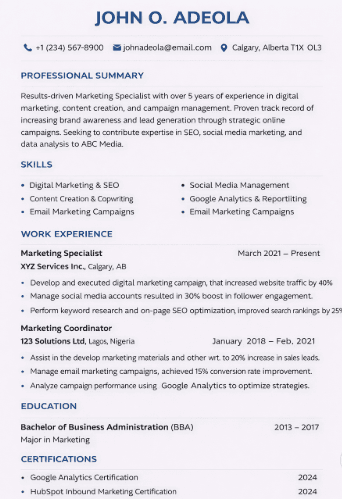
Step 1: Start with Your Contact Information
At the top include:
- Full name
- Phone number
- Professional email
- Location (City + Country)
- LinkedIn (optional)
Do NOT include your Age, Marital status, Religion, or state of origin
Step 2: Write a Powerful Professional Summary
This is a short paragraph (3–4 lines) at the top. It should explain the following;
Who you are
Your experience
Your key skills
What job are you looking for
Example:
Results-driven Digital Marketer with 4+ years of experience in social media, SEO, and online advertising. Proven ability to increase brand visibility and generate leads. Seeking to contribute marketing expertise to a global organization.
Step 3: Add Your Skills Section
List your most relevant skills.
Example:
Digital Marketing
Customer Service
Data Analysis
Project Management
Communication Skills
Use bullet points to list the skills
Step 4: Add Your Work Experience
This is the most important section. For each job, include the following;
- Job title
- Company name
- Location
- Dates
- Achievements
Example:
Marketing Specialist
XYZ Company, Lagos, Nigeria
2021 – Present
Increased website traffic by 40% through SEO strategy
Managed social media accounts with 30% engagement growth
Created email campaigns with 15% conversion rate
Focus on results, not duties.
Step 5: Add Your Education
Include:
- Degree
- School
- Year
Example:
Bachelor of Science in Economics
University of Benin
2016 – 2020
Step 6: Add Certifications (Very Important)
International employers value certifications.
Examples:
Google Digital Marketing
HubSpot Marketing
Project Management (PMP)
Data Analytics
Step 7: Add Optional Sections
You can also include:
- Volunteer work
- Projects
- Awards
- Languages
My Personal Experience Helping Nigerians with CVs
From my experience working with people through Educatefresh, I have seen many talented individuals struggle to get interviews because of poor CV formatting.
Some of the issues I noticed are;
Too much personal information
No clear achievements
Weak professional summary
No international keywords
After helping them restructure their CV into international format, many of them started receiving interview invitations within weeks.
This shows that your CV is not just a document — it is your marketing tool.
Common CV Mistakes Nigerians Must Avoid
The mistakes listed below should be avoided;
- Using One CV for Every Job: Each job is different. Customize your CV for each application.
- Writing Responsibilities Instead of Achievements: Instead of writing “Responsible for managing social media, ” simply write “Grew social media engagement by 30%.”
- Too Many Pages: An international CV should be 1–2 pages maximum
- Using Unprofessional Email: Avoid emails like coolboy123@gmail.com. Instead use firstname.lastname@gmail.com
- Spelling and Grammar Errors: Always proofread your CV.
Proven Tips to Make Your CV Stand Out
Below are the tips you should follow to make your curriculum vitae stand out.
Use Keywords from Job Description
Many companies use ATS (Applicant Tracking System). Include keywords from the job post.
Use Action Words
Examples:
Led
Managed
Created
Improved
Increased
Show Results with Numbers
Numbers make your CV stronger. Example: “Increased sales by 25%.”
Keep Design Simple and Clean
Avoid too many colors or fancy designs.
CV Format for Different Countries
Canada
Resume style
No photo
1–2 pages
UK
CV format
2 pages
Clear sections
USA
Resume style
Achievement-focused
Simple CV Template You Can Copy
Use this structure:
NAME
Phone | Email | Location
PROFESSIONAL SUMMARY
SKILLS
WORK EXPERIENCE
EDUCATION
CERTIFICATIONS
Frequently Asked Questions (FAQs)
Below are some of the frequently asked questions concerning how to write a CV for International Jobs from Nigeria.
1. What is the best CV format for international jobs from Nigeria?
The best CV format for international jobs is a clean, professional, and achievement-focused format.
Your CV should:
- Be 1–2 pages long
- Have clear headings (Summary, Skills, Experience, Education)
- Focus on measurable achievements
- Use simple and professional language
Avoid unnecessary personal details such as age, religion, marital status, or passport photograph.
2. Should I include my photo in my CV?
In most countries like Canada, the UK, and the USA:
No, you should not include your photo.
Including a photo can even reduce your chances because many employers follow anti-discrimination policies and prefer not to see personal identity details.
3. How long should my CV be?
For most international job applications: 1–2 pages maximum. Only academic CVs or research roles may require longer documents.
4. Can I use the same CV for all job applications?
No. Each job has different requirements, so you should:
- Customize your CV
- Adjust your skills and keywords
- Match your experience to the job description
This increases your chances of passing ATS (Applicant Tracking System).
5. What is the difference between a CV and a resume?
A CV is usually:
- More detailed
- Used for academic or research roles
A resume is:
- Shorter (1–2 pages)
- Used for general job applications
However, in many countries, the terms are used interchangeably.
6. What should I include in my professional summary?
Your professional summary should include the following;
- Your job title or profession
- Years of experience
- Key skills
- Career goal
Example:
“Results-driven Customer Service Specialist with 4+ years of experience in client relations, problem-solving, and communication, seeking to contribute to a global organization.”
7. How can I write achievements if I don’t have much experience?
Even if you don’t have formal work experience, you can include:
- Internship experience
- Volunteer work
- School projects
- Freelance work
- Personal projects
Focus on what you achieved or improved.
8. Can a good CV guarantee a job?
A good CV increases your chances, but you also need:
- Skills
- Interview performance
9. What file format should I use when submitting my CV?
The best format is: PDF
You may ask, Why?
- Keeps your formatting intact
- Looks professional
- Opens on all devices
Conclusion
Getting an international job starts with a strong CV. Once you understand how to write a CV for international jobs from Nigeria, your chances of getting interviews and job offers increase significantly.
Your CV is your personal marketing tool—make it clear, professional, and results-focused. Take time to build it properly, improve your skills, and apply consistently.
Your next job opportunity could be one CV away.
Meanwhile, feel free to share this article on your social media accounts so that others can learn from it.